How the schedule is put together
Each round starts with who sits out. Players with the fewest rests so far sit first, so at any point in the session nobody has rested more than one round more than anyone else. The generator also avoids resting the same player twice in a row when someone else could sit instead.
Then it pairs up everyone who is playing. It swaps players between courts until it can't cut down repeat partners or spread out opponents any further. It builds the whole schedule several times, up to 80, and keeps the best one.
The grey box above the schedule tells you how it went: how many games each player gets, how many rounds they sit out, and whether any pair partners twice. Ask for more rounds than there are fresh pairings and some repeats can't be avoided. In that case the box says the repeats are the fewest possible.
Choosing the number of rounds
When everyone plays every round, it takes one round fewer than the number of players for each player to partner every other player once. That's 7 rounds for 8 players and 11 rounds for 12. When players sit out it takes longer, and the note under Rounds gives the number for your group.
Most sessions are set by court time rather than by that number. Two hours at 15 minutes a round is 8 rounds. The rounds and time table shows how many games each player gets for different group sizes.
The four formats
- Rotating partners. A new partner each round, and each player is ranked on their own wins and points.
- Mixed doubles. Two lists, and every pair has one player from each. Rests are shared within each list, so if one list is longer, its players sit out more often.
- Fixed partners. Each line is a pair that stays together. Every pair plays every other pair once, or twice if you tick Play everyone twice.
- Singles. One player per line, and everyone plays everyone.
Scores and standings
Type each game's score into the boxes and the standings update straight away. If some players have played fewer games because they sat out more, the table ranks by win percentage instead of total wins, so nobody drops down the order for resting.
Scores are saved in your browser. Close the tab, come back later, and they are still there. Start over clears everything.
Printing and sharing
Print gives you the rounds two to a row with empty score boxes, ready to pin up by the courts or hand out. Open "Each player's games" first if you want a card for each player as well, with their court, partner and opponents for every round.
Copy share link puts the names, settings and scores into a link you can text to the group. Everyone who opens it sees the same schedule. The link itself carries the schedule, so nothing is stored on a server.
Questions people ask
How does a pickleball round robin work?
Everyone plays a set number of short games, often to 11 points. In the rotating partners format you get a new partner and new opponents each round, and you collect your own wins and points. After the last round, the player with the most wins comes first. Point difference splits players on the same number of wins.
How many players do I need?
At least 4 for doubles, or 2 for singles. After that any number works. Players who don't fit on a court sit out that round, and the rests rotate. The generator takes up to 80 names.
What if my number of players doesn't divide by 4?
Then some players sit out each round. With 9 players and 2 courts, 1 sits out. With 10, 2 sit out, and with 11, 3 sit out. The schedule shares the rests so nobody sits out more than one round more than anyone else. See round robins for odd numbers of players for worked examples.
How many courts do I need?
One court for every 4 players. With 12 players, 3 courts means everyone plays every round. With 2 courts, 4 players rest each round. If you enter more courts than you can fill, the extra ones stay empty and the schedule says so.
Can I make a 4 team round robin?
Yes. Choose Fixed partners and enter the 4 teams, one pair per line. You get 3 rounds of 2 games, and every team plays the other three once. The 4 team round robin page has the schedule written out and timings for 1 or 2 courts.
How long does a round robin take?
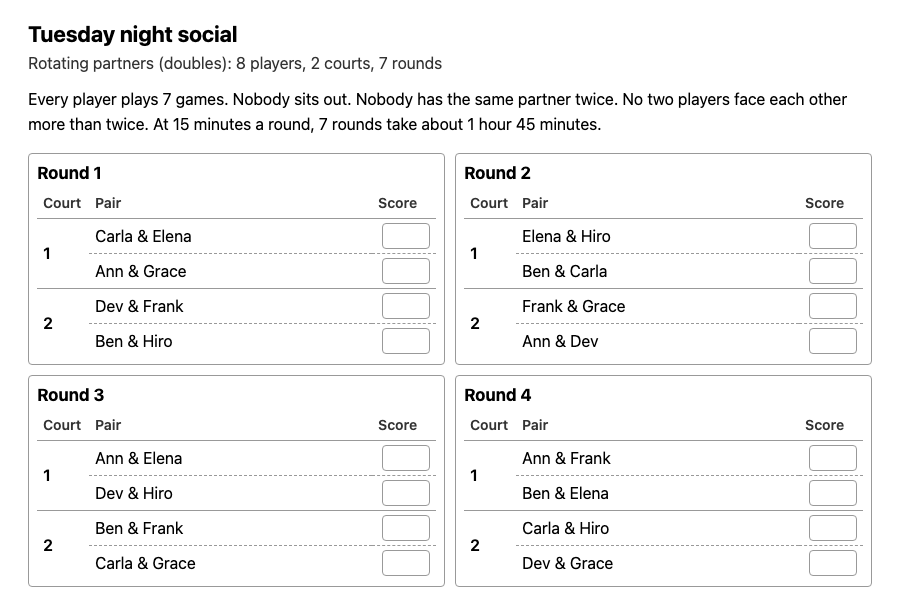
Multiply the rounds by the minutes per round. 8 players playing 7 rounds of 15 minutes takes 1 hour 45 minutes. The rounds and time page has a table for 4 to 24 players and 1 to 5 courts.
Can I change a name after making the schedule?
Yes. Fixing a spelling or swapping one name for another keeps the same schedule and any scores you entered. Adding or removing a name changes the number of players, so the generator builds a new schedule.
How are ties broken in the standings?
Most wins first, then point difference, then total points scored. If two players are still level after that, settle it the way your club usually does, for example by who won when they played each other.
Do I need an account?
No. The generator runs in your browser. Your names and scores are saved on your own device so they survive a reload, and nothing is sent to a server.